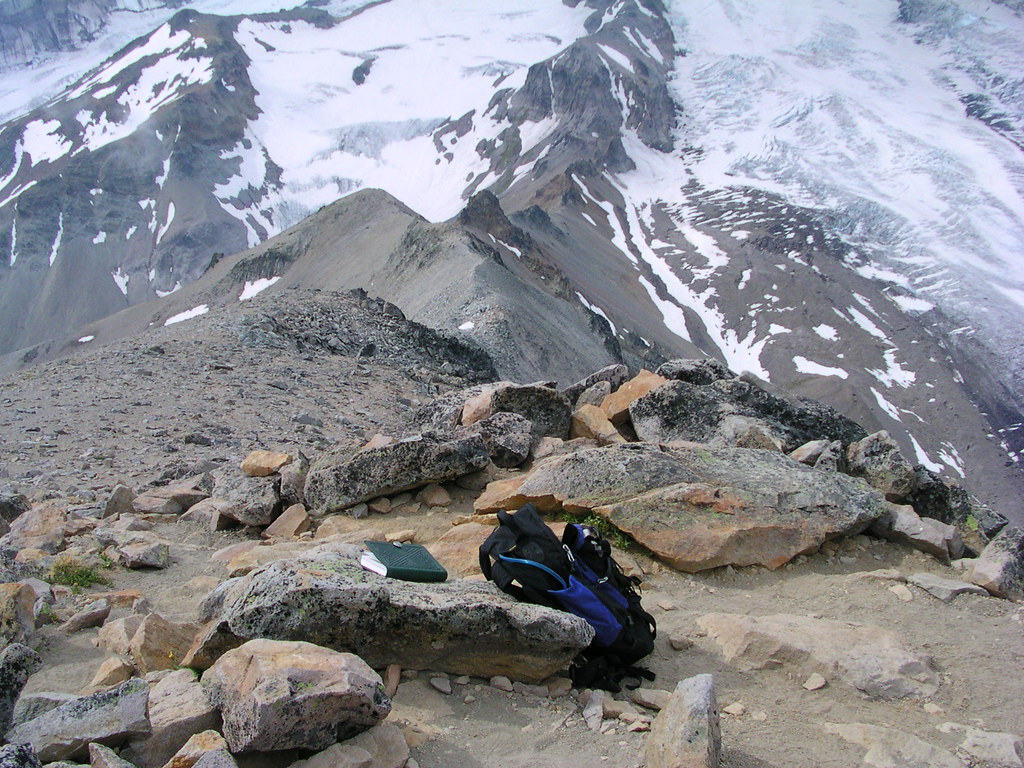
Let me begin my review in the middle of Outlive. The author asks us to list the ten tasks we want to do for the rest of our lives. He calls this list the centenarian decathlon. Here’s the top of the list for me: hike up to Third Burroughs Mountain. It’s 9 miles (14 km) in Mount Rainier National Park with 2500 feet (760 m.) of elevation gain. Why? I’m a hiker, and this is my favorite hike worldwide.
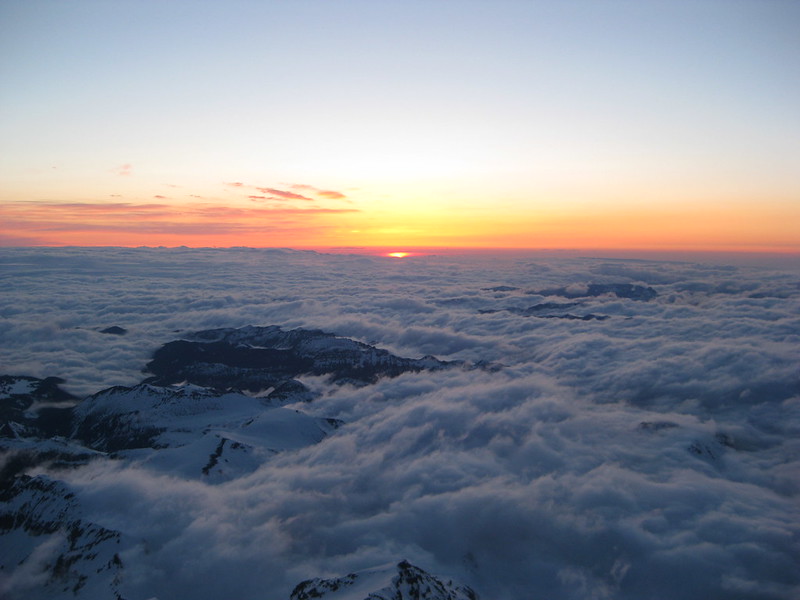
Early morning at Third Burroughs 2003
I’ve spent a fair amount of time thinking about how to keep hiking as I get older. I turned 65 in 2022; I would like to keep exploring mountains as long as possible, this is just the book to help me achieve my goal. Let me explain why.
First, Attia starts with the concept of healthspan – how well you live. There’s a tight coupling between healthspan and lifespan. As we age, we have left less of each. One difference is that lifespan is a discrete quantity; one day, you are alive, and the next, you are not. In contrast, our healthspan gradually diminishes over time. The author details three vectors (components) of healthspan: physical, cognitive, and emotional. The good news is that we can usually improve these components and our overall healthspan. How we do so is the core of the book.
The book’s first part outlines our current situation and a target goal. The most important lesson I learned: “Tactics without strategy is the noise before defeat.” a quote from Sun Tzu, an ancient Chinese military strategist. Been there, done that, got the T-shirt. So, how can I do better? The author has a great framework: first, objectives, then strategy, and finally, tactics. The author trained as an engineer, became a physician, and has worked in business consulting; his background shows throughout the book. I touched on objectives in the discussion of the centenarian decathlon; how about strategy?
The second part of Outlive is the science that can help you develop a strategy. There is a chapter on the science of centenarians; I think of this as a boundary condition. What are the factors that helped get someone to their 100th birthday? (I have a hiking friend who still gets out on walks at 101, I want to follow in her footsteps.) Next is a chapter on the details of how nutrition affects longevity. The last four chapters cover the science of how most of us die: metabolic disorders such as diabetes, heart disease, cancer, and neurodegenerative diseases. Understanding these problems will help you develop tactics to mitigate some issues. There are no magic bullets in these chapters; instead, it’s a well-researched survey of what we know as of 2022. Now that we know objectives and strategies, what tactics can we employ?
The final part of Outlive lays out four tactics:
Exercise (cardio, strength, and stability)
Nutrition
Sleep
Emotional health.
At 260 pages, this is the longest part of the book. It was detailed and beneficial to me. Rather than outline each section, let me list some tactics I am adding to my strategy:
Work on stability, specifically starting with a yoga class.
Use a continuous glucose monitor for a few months to optimize my diet.
Ensure I am getting enough protein intake of lysine, leucine, and methionine.
The last chapter on emotional health was the most impactful in the book. Attia opens up to the reader about his emotional health through the lens of a patient rather than a physician. It touched me deeply; I had some trauma in my teen years when my mom died. Fifty years later, I realized I should address some of these issues rather than wall them off.
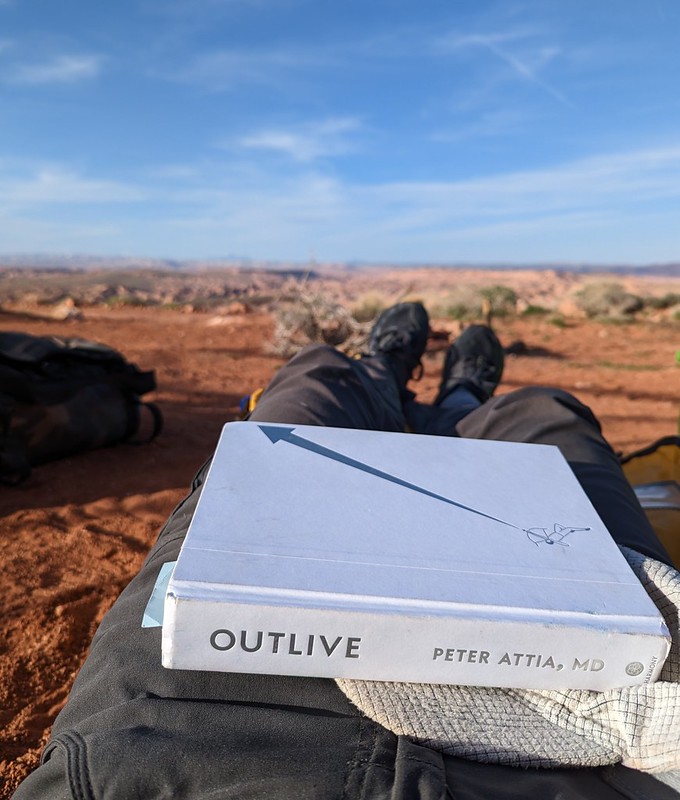
Outlive is a book I will read several times. The book is challenging; I spent four weeks reading the book.
Reading in camp at Grand Staircase-Escalante National Monument, Utah
I made a ton of margin notes and back-of-the-book scrawling. There’s a lot to digest, and there are many references. For example, I want to read the paper Hallmarks of Aging by Carlos López-Otín and colleagues. This book catalyzed some great conversations with my friend Bill about healthspan. I will recommend Outlive to anyone interested in taking action to improve their healthspan.
One closing thought; there’s a missing chapter in the book. I believe social interaction and engagement can improve healthspan’s cognitive and emotional components. My experience is that forty years of marriage have improved my emotional health. I decided to ask ChatGPT: What studies have shown that social interaction and engagement can improve cognitive function and reduce the risk of cognitive decline and dementia in older adults? Here’s the answer:
“There have been several studies that have shown a positive correlation between social interaction and cognitive function in older adults. For example:
The Rush Memory and Aging Project: This study found that older adults who had higher levels of social activity experienced a slower rate of cognitive decline than those who were less socially active.
The MacArthur Study of Successful Aging: This study found that older adults who were more socially engaged were less likely to experience declines in cognitive function over time.
The Women’s Health Initiative Memory Study: This study found that women who reported higher levels of social engagement had a lower risk of developing cognitive impairment than those who were less socially engaged.
Overall, these studies suggest that social interaction and engagement can play an important role in maintaining cognitive function and reducing the risk of cognitive decline and dementia in older adults.”
One of my goals for 2022 is to explore Tahoma (Mount Rainier) every month of the year. Why? Because Tahoma is my favorite place to hike and yet I tend to go to the same places over and over. There’s nothing wrong with that: I hope I get to Burroughs Mountain to see the alpine flowers every year I can.
When I did some research, I found an excellent site by Shawn Hargreaves with the handy name of Hiking Tahoma. Shawn is a kindred spirit, he’s laid out a clever interactive map of all the maintained trails on Tahoma. I am now studying what to explore over the year. A few trails that I need to try out: Boundary Trail to Florence Peak, Camp Muir, Eagle Peak, Eastside PCT Loop, Klapatche Park, Northern Loop, South Puyallup Pipe Organ and Tamanos Mountain. I also want to get back to some lesser known trails such as Curtis Ridge. So many hikes, so little time. I feel a need to focus on Tahoma. Along with hiking, I aspire to observe and understand the natural history on each of my hikes.
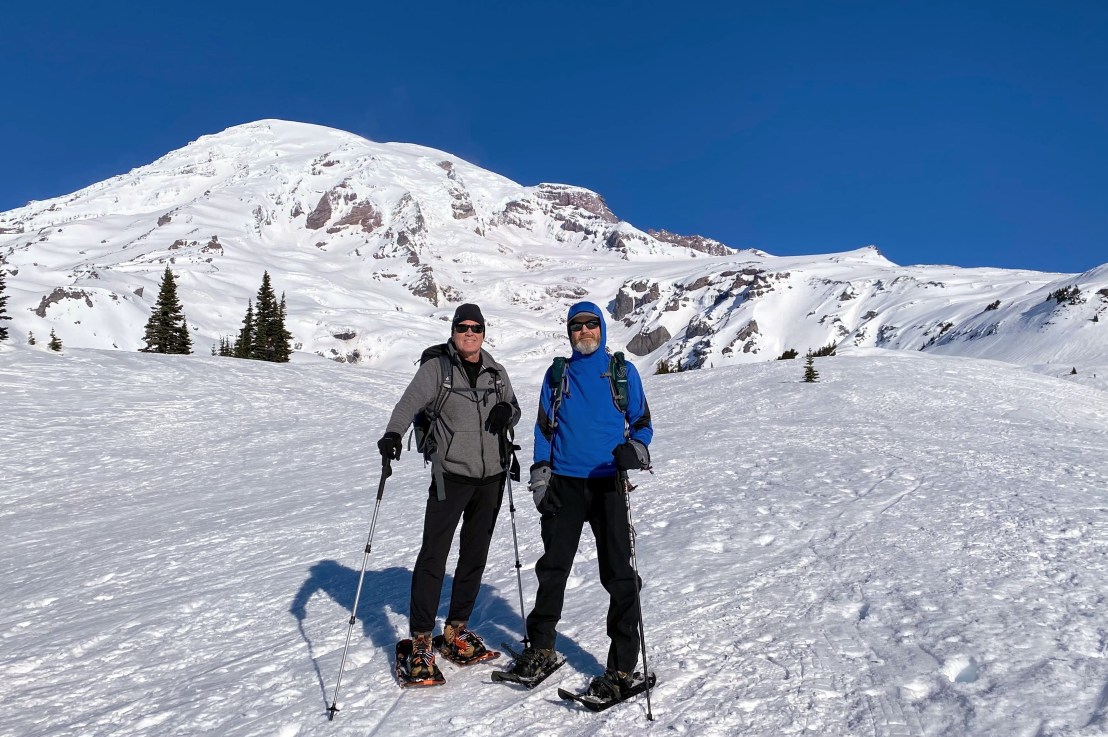
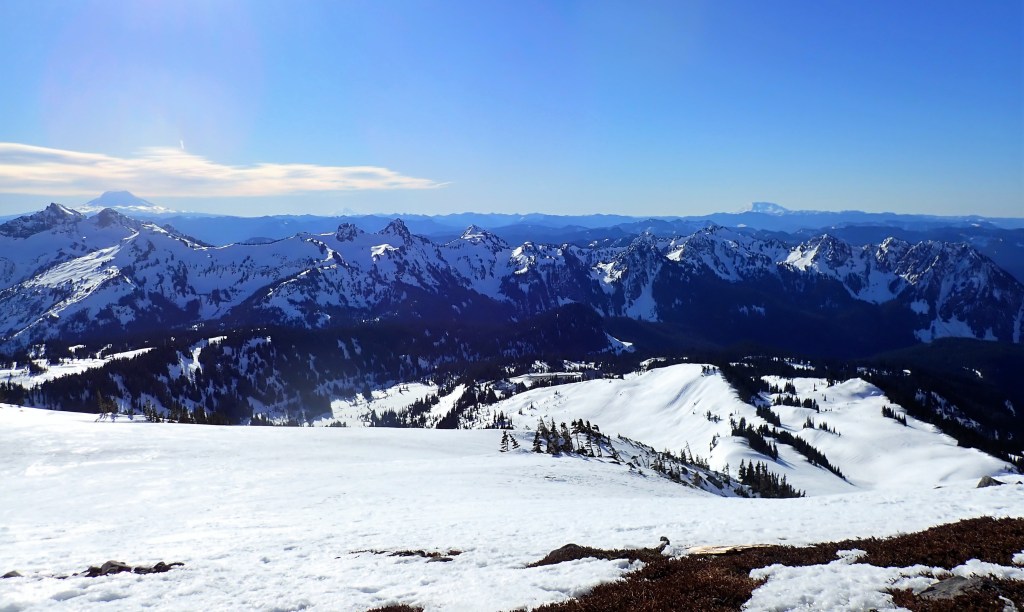
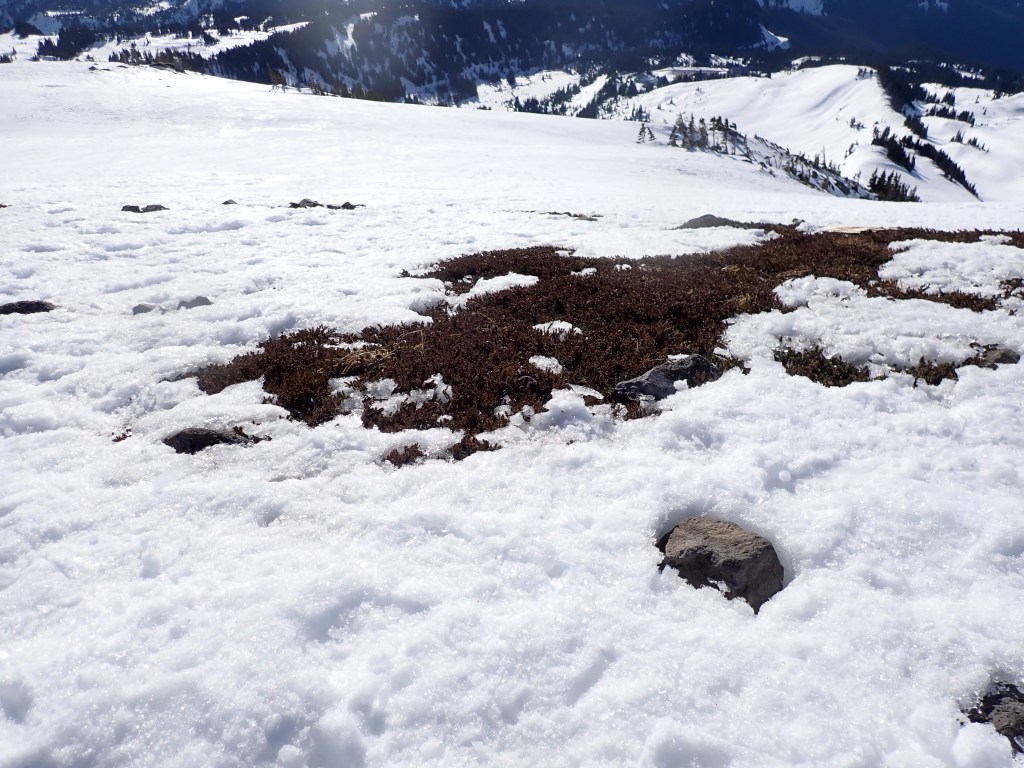
Meanwhile, I did make it to Tahoma on 27 January, 2022. My friend Mike and I had a great day on the mountain. We snowshoed about 5 km (3 miles) with about 400 meters (1400 ft) of elevation gain. As you can see from the photo, we had nice weather. In fact, it was much nicer up here than in the cold, foggy Puget Trough thanks to a temperature inversion. It was a four volcano day: Tahoma, Adams, Hood, and Mount St Helens were all visible. If you look near the upper right corner, I think you can see the road where we started far below.
I was able to see a few plants and trees along the way. Here are my naturalist observations for 24 January 2022. My plant of the day was a patch of common juniper growing in a rocky, windswept areas at 2000 meter (6600 feet). This was our lunch spot.
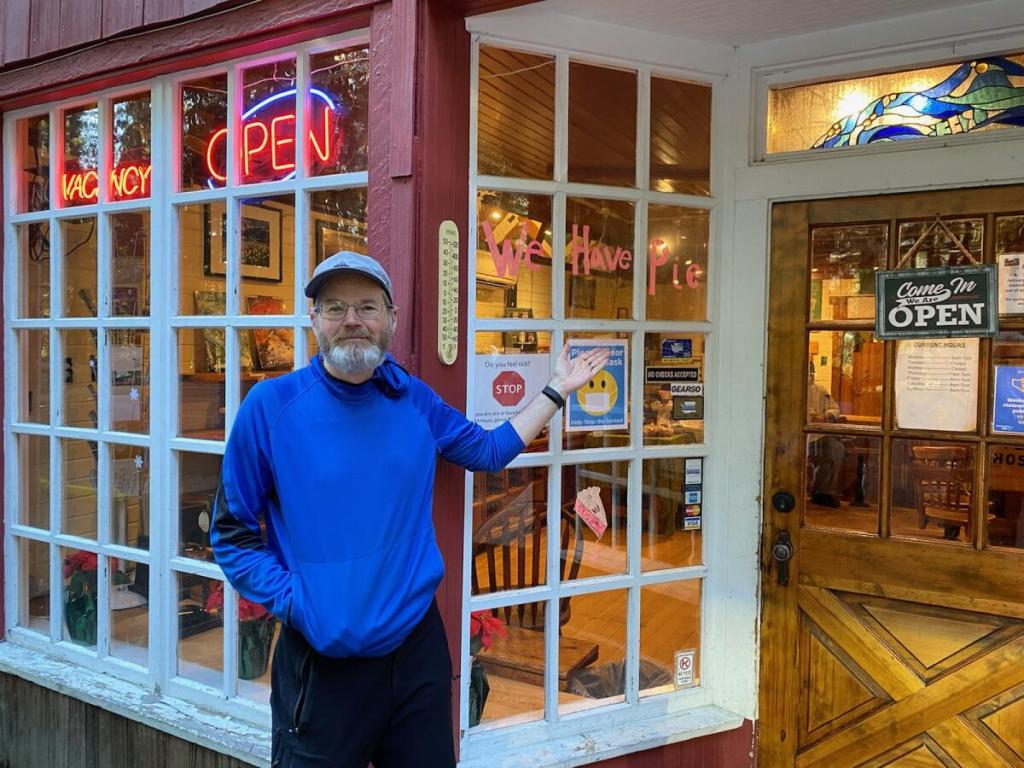
We worked pretty hard heading up. Coming down , we were able to get in a couple of glissades ( in other words, slide on our butts in the snow done some steep slopes). After some hard work, I was happy to stop at the Copper Creek Restaurant and see WE HAVE PIES. Specifically, delicious blackberry pie. Hmm, there may have been ice cream as well.
I’ve lived in Western Washington state since 1977. I can remember the first time I saw Mount Rainier was about a week after I moved to Tacoma. My colleagues told me about this big mountain but the weather had been cloudy and gray. Then, one day I walked outdoors and there was Mount Rainier in all its glory. It has become my favorite place on earth to explore.
I have hiked many of the trails and spent a lot of time observing the natural world of Rainier. I often looked toward the summit and wondered what it would be like up there. As I got older, my fitness level and overall health declined. In my mid-forties, I decided to get back in shape. (That’s a separate saga). In 2009, in the midst of a hectic engineering career, I decided I wanted to climb Rainier. It took me about two years to get ready due to work and life but eventually I made it to the summit in June, 2011 at age 53. I was on a guided climb with International Mountain Guides on the Emmons-Winthrop route; my favorite side of Rainier.
Here is my journal for the climb to the summit: Got up on the night of 6 June, about 11 PM after some fitful sleep. I was mostly dressed, it had been quite windy as we “slept”. I popped out and headed to the food tent. Our lead guide Greg had hot water going, and I had two packs of instant oatmeal. It was darn good. Had some black coffee and then back to tent to grab gear. Got my harness secure, headlamp on. Don’t want to forget anything!
Back out and we all assemble just above the tents. I am on guide Jess’s rope team – with Dmitri and Jeff. We have a brief interlude while the other teams rope up. I take a chance to just look around, the first time tonight. It is cold and there is quite a wind coming down from the mountain. The stars are brilliant, so clear, so near. Just after midnight, and it is time to get to work heading up the Emmons glacier. We move out slowly and surely heading up the mountain, using our headlamps to navigate. I see pools of light ahead of me starting up the mountain.
It’s some work, but not too bad as my pack is only about 10 kg. (22 lbs.). We go up slow and steady. My focus is just in front of me – no missed steps. First break is after about an hour. I feel great. The stars are brilliant, Get my puffy down parka on, it is cold and windy. Sit on my pack and drink some water. Eat a little snack. We are last of four rope teams. In last, leave last. After about 10 minutes: puffy off, last sip of water, pack on and head up the hill.
We are entering the corridor and the glacier is steeper. Climb methodically and steady for the next hour and have our next break. Stars are so visible, it’s a great night. The wind is blowing ice crystals, I was glad to have goggles on. It’s like an ice desert tilted upward.
Now, it seems steeper still and the wind is really howling. I am thankful that we have goggles, they were necessary. Start to try some sideways walking. We cross a snow bridge over a crevasse. I am starting to feel tired; but not too bad. At our third break (about 330), a couple of people turn back with one of our guides. Our remaining three rope teams head up. It’s steep and hard; now I am very physically tired. Have to pull in mental reserves. The rosy fingers of dawn are emerging on this section.
Next break – I am physically blown. I debate whether to continue; but I do. It is steep, I am tired, and I pull in mentally. The wind is blowing hard up here at first light, it is like a beautiful white desert up here at first light. I stumbled a few times but pull myself up. Our guide Jess asks: “Do you want to keep going?” I answer:”YES”. Jess says: “THEN LETS GO!” And I go. And go, one step at a time. Then I see another team, then are on the crater rim, it’s about 500 feet. I can make it, and do.
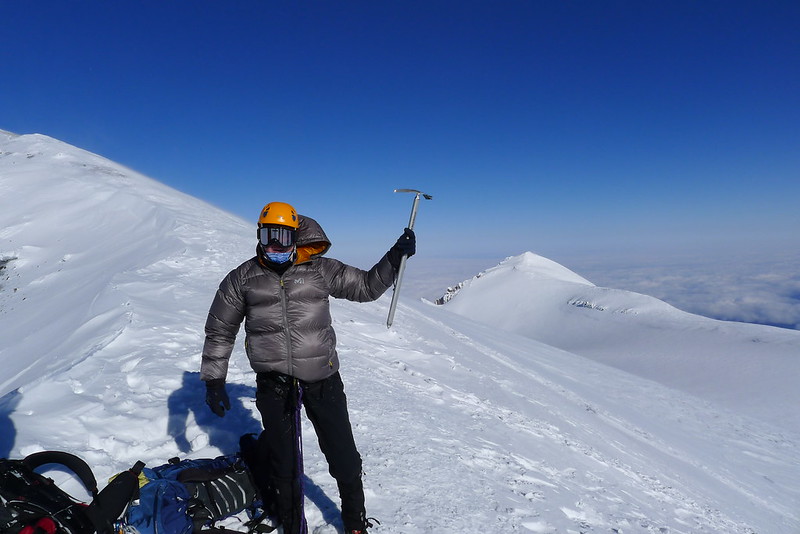
Get up on the crater rim – and just lay down for a minute. Really pretty tired, just lay down for a minute. Get up, and shake hands with Jess and Greg. I was very happy to get up here!. Start looking around, it is a beautiful early morning. There is the crater below us, and I notice a lot of clear ice around us. The crater is much larger than I thought. I would like to explore up here – but not today. In the distance I see Mount Adams above the clouds, I climbed that with my friend Roger in 2003. ‘d like to do that again. Tried getting my camera to work. No luck even though it was in my inner layer. I checked after the climb – it was -12 C (10 F) with about 65 km/hr (40 mph) wind. One of my rope mates snapped my picture. After about 10 minutes it is time to head down.
Summit of Rainier 5 AM
Heading Down from the Summit It is quite steep looking down. I really didn’t notice how steep that coming up in the dark. Well – the climb is not over until we are down. Down the Emmons glacier we go, following the other rope teams. Jeff leads us down, then Dmitri, then me, with Jess in the back. We plunge step – I am slow, We proceed down, one step at a time. My focus is to keep my balance, keep the rope taut, but my mind is a bit fuzzy and my legs are quaking. Just keep going. Knee’s bent, nose over toes. Plunge, plunge, plunge.
Plunge on down quite a while. I’m stumbling a bit, my quadriceps are burning bad. Try to keep going but I stumble and fall, but recover. A while later, I fall again; pretty bad. But back up and going. We need to get going, it’s not good to be up here as it warms up. Jess tells us: “Get going, Get down.”
We take a break, I am feeling sort of out of it. I’m just not that alert. Forget to eat during the break. Going again. Legs very tired. I stumble and inadvertently yank Dmitri down – not a good moment. We cross a crevasse on a snow bridge. Now I see it is very deep, but we don’t linger. We skirt around a few more crevasses but that was the only one we had to cross over. Continue down. My right boot is loose, which I did not notice for a while. We stop, I also notice my crampon is loose. No idea how, maybe from falling down. Jess helps me get fixed up.
More, more more plunge stepping, If I stumble, then everyone is going to stumble, I did need to stop a few times. I am slow – but going. Now it is starting to warm up. The sun is intense, but it is still windy. Little Tahoma is on our right. I remember it is above 11,00 feet and we are now below it, so we’re making progress. We have some crevasses to go around.
Finally, I see Camp Schurman below. Yeah! We stop – I eat some Energy Gel with caffeine and drink quite a bit of water. I was not hydrating enough going down, that was stupid!
Get up, get going. Some more stumbling but we get into Camp Schurman. Unrope. Crampons and harness off. I have some hot soup, it is delicious. Drink a liter of water and then take a nap. I think that was the hardest physical day I ever had.
Lessons Learned on Summit Day 1. Should have eaten more and drank more water especially coming down. 2. Should have trained on downhill more. My quads were weak! My balance was also not good. 3. Maybe I should have turned back instead of going on to the summit. (But honestly, I am glad I continued). My regret there is I caused my rope team to be slow and and stumble too many times. 4. Whenever I see Rainier (which is almost every day it’s visible) I see it in a different light. I am grateful to my excellent guides, especially Jess, the people I climbed with, my trainers Laurie and Nate, my wife for being patient while I trained for this.
Here is the rest of the story of leaving Camp Schurman ~2900 m. (9500 ft) on the Emmons Glacier and heading down the Inter Glacier and then the Glacier Basin trail to White River camp at 1250 m. (4100 ft.)
We get awakened the morning after our summit climb by our guides. There is a raging storm outside. We get geared up, climbing harness on, and grab some food. It is hard to walk 10 meters to the cook tent. I have hot water and energy bar, all I can handle right now.
Back to the tent, we get in and wait. The plan is to take down each tent in sequence and then go rope up and get down. If I was at home… I wouldn’t even open my front door. Instead, we are about to go down off the Emmons Glacier, then down the Inter Glacier, wow! I trust our guides, they are excellent, so I am going with the plan.
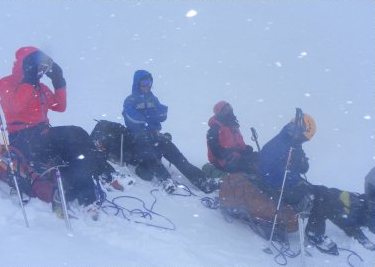
We get our tent down, I had to pull my gloves off during this time.(That turned out to be stupid!) It is really blowing. I have a hard time with the harness, can’t seem to move my fingers too well. We are in two rope teams today. We head out, I can’t see very far and the wind is very strong. It is snowing and blowing but I feel OK. I notice that my thumbs feel a bit strange in my mittens, they don’t seem to fit quite right.
Roped Up and Waiting to Leave Camp Schurman
After quite a walk – perhaps 2 hours, the weather improves and we take a break. When I get a snack out of my back, I notice my thumb looks a little strange but think noting of it. After a short while, we are on the go.
I’m now postholing quite a bit as we walk. It’s quite tiring – and a bit maddening. The right way to deal with this is to maintain momentum and walk right out of the posthole. As I tire out; I can’t do that any more. After about 30 minutes of this (and others are experiencing this fun); we stop for a break and get set to glissade. Effectively, that means controlled sliding on your butt, using your ice axe as a brake. Excellent, down I go; that is fun and we get to lose maybe 1000 feet of elevation rather quickly. We take a short break, and I notice that skin on both thumbs and a couple of fingers are peeling. My fingers feel a bit numb but also ache, I let our guides know – it’s likely frostbite. They wrap up the three fingers that look the worst (they are already thawed).
Now we’re waking in a snow field in Glacier Basin, I am with two guides and one other climber. (We are the two older people in the group) After maybe 30 minutes, we meet up with our lead guide, Greg. He is a little puzzled by my fingers; he hasn’t seen anything like this before.
We head down; I’m hurting a bit as we plod along the White River. There is a lot of snow here in early June (about 3 meters) and we need to be careful over snow bridges. I’m putting one foot in front of the other. I’m tired; but nothing like coming down from the summit on the previous day. We make it in to White River campground and meet our van driver. I have a Coke and some Ibuprofen. Hands are hurting quite a bit. We head back to Ashford, then it’s back to Seattle and the ER for me.
Postscript I took three trips to Swedish Hospital – Edmonds for surgical debridement over about three weeks before my finger tips healed up from frostbite. In the end, 8 out of 10 fingers were affected. The good news is that after a month; back to normal (almost) with no lasting damage. (Ten years later, there was some nerve damage and my hands get cold easily but I have learned to live with this.)
Lessons Learned In the Storm 1. Bare hands are dumb, dumb, dumb. I should have used my glove liners (even though at the time I felt “OK” 2. I take blood pressure meds, and that made my periphery (hands and feet) more susceptible to cold. I had really good boots, so feet were not an issue. I need to be a lot more carful of my hands in the future.
Training Lessons Learned I had quite a few weak areas when I started getting ready to climb Rainier (18 Months before the climb). In particular, I had a hard time carrying more than a 40 pound pack. Since I needed to be able to do 55 pounds on some serious elevation gain, I had work to do. In January, 2010 I was out of shape, weighed 86 kg. (190 lbs.) and let’s say it was not all muscle. My cardio capability was perhaps a little better than average due to hiking. My balance was quite poor. I just turned 52 years old when I started and I thought I’d be ready to go in 3 or 4 months. It took longer – and honestly, next time, I need to train even harder.
I learned a few lessons about training, here they are: 1. Working with a personal trainer was very good to do because they helped me work my weak areas – and found more weak spots to work! I never got injured working out with a trainer (or doing a workout they helped design). In particular, working with a trainer improved my strength, balance and flexibility. 2. Find a trainer that is a good match. My first trainer was a boxer, he challenged me – but it wasn’t the best match. The next trainer was closer, but with both these 20-something guys, it was mostly about strength. My current trainer, Laurie, is about my age and is just a better match. She got me working balanced and helped me solve some range of motion issues in my shoulders – both of these turned out to be important. 3. I found The Outdoor Athlete by Courtenay Schurman and Doug Schurman to be a very useful reference for me. In particular, it helped me get my cardio regime going. I ended up designing my own cardio program based on great guidance from this book. 4. Training outdoor and doing lots of early winter and spring slogs with a pack up some serious elevation gain was useful
Some Things I Need to Work On (I Hope to Repeat Rainier And Other Local Peaks) 1. Need to train for a longer duration. I did do one day where I went 10 miles and then 7 miles for a total of 17 miles in a day – but it wasn’t continuous. Really need to do a 12 hour workout, because that was our summit day, and the next day was maybe 7 hours. (It’s not just physical – some of this is to train your mind as well.) 2. I did not get enough downhill training – and that is what really worked me over on Rainier. I had times where I hit the failure point on my quads coming down – that was not good. 3. Still need to work on balance and strength.
Well – sorry to be long winded, but if this is useful to one other older climber, I’ll be happy.
Postscript – Ten Years Later (2021) I think about the summit of Rainier pretty often. I see the mountain many days and try to spend time every year hiking the trails. Will I ever go up again? Possibly. I am much stronger and fitter that I was ten years ago, I spend a lot of time in the mountains, hiking and running. Also, I think I can avoid some stupid mistakes. I will be up in the Sierras this summer walking the John Muir trail and thinking about what to do next.
PPS – Writing this especially for older climbers to read and learn a few lessons a bit more easily than I did.
Me at the snout of Carbon Glacier, Mount Rainier, 2012
For me, it’s Mount Rainier National park, a large volcano of the Cascade volcano chain in North America. Why?
I have been hiking here for 43 years, since I was a teenager. I have seen changes occur over the years: ice caves have closed, floods have occurred, roads have closed.
My family and friends have had many great days on this mountain. I’ve never had anyone regret spending time here.
Next, I have spent a good chunk of my life learning the flora, fauna, geology and ecology of this mountain region. There’s always something new to learn here.
It’s also fairly easy for me to access. In fact, the local Cascade and Olympic mountains are why I live near Seattle, Washington.
Exploring here is never boring. I have spent much of my time exploring the alpine areas above 2000 meters. There are also dense forests. fast moving rivers, lakes and many wonderful places. While not a mountaineer, I climbed the heavily glaciated 4392 meter summit in 2011.
Finally, it’s just a place I love.
For each of us the answer’s going to be different. How would you answer this question?

 brewbooks