Category: walking

 Six hours in Edinburgh

My wife and I went on a ten-day cruise around the UK in late spring 2023, with stops in Scotland, Wales, Ireland and England. Whenever I could, I tried to explore on foot. On our first stop, I did a nice urban hike around Edinburgh, Scotland. My last visit to the city was back in 2006. I wanted to visit Arthur’s Seat and the Royal Mile. I also had a mission to get my wife a new folding cane; I forgot her cane when we left home zero dark early for the airport. Well, at least we remembered our passports!

The day started with dismal weather; I was glad for a rain jacket and wool gloves. I caught a tender from the boat into the harbor and a bus from the cruise ship terminal into the city. In hindsight, I should have walked from the pier and skipped the expensive bus ride offered by the cruise line. Oh well, another lesson learned. 

I started from Queen Charlotte Square, intending to wander over to Arthur’s Seat. The city was hectic, but I got off the beaten path quickly. I navigated using the Gaia mapping app; it worked well for the entire trip. My first stop was Greyfriars Kirkyard Cemetery; I found the design of the old gravestones interesting.

Greyfriars Kirkyard Cemetery

I spent ten minutes exploring. I realized I needed a second breakfast and a toilet. The University of Edinburgh was close, so that would be my next stop. I found respite at Levels Cafe; it made for a nice break. It’s part of the University of Edinburgh; there was an excellent food selection and good coffee. I had a touch of jet lag; a large Americano cleared my head. I mainly eat a plant-based diet but I couldn’t resist an almond croissant this morning. I’m a flexitarian when it comes to sweets.

A break at University of Edinburgh

Suitably fortified, I was off to Holyrood Park and Arthur’s Seat. It’s pretty easy to spot.

Holyrood Park, the way to Arthur's Seat (and a good spot for running)
Holyrood Park, the way to Arthur’s Seat (and a good spot for running)

There are multiple approaches to Arthur’s Seat as seen on my Gaia map.

Map of Arthur's seat hike

I went about halfway around the circumference of the park and then started up just past Raven’s Rock. I missed stopping at Hutton’s Section, an area I had explored back in 2006. I’m not certain but I think the trail was closed here. I took a reasonably direct ascent via rough steps on the way up. I took a much gentler path on the descent.

Scottish Slot Canyon - most of the path up was better than this!
Scottish Slot Canyon – most of the path up was better than this!
On top of Arthur's Seat
On top of Arthur’s Seat

I like exploring volcanic areas; Arthur’s Seat is the remnant of a volcano from 330 million years ago. Scottish geologist James Hutton used the rock in this area to support his theory that we can infer ancient geology from modern rocks. I focused on geology on my first trip here in 2006. Today my goal was a walk in the park, hoping to get an overview of the city. Sadly, the weather didn’t cooperate. Still, it was a worthwhile urban hike. 

Descent from Arthur's Seat
Descent from Arthur’s Seat

Next, I headed to Edinburgh City Center. I walked up and down the Royal Mile with a side trip to a Boots pharmacy at the train station to see if I could find a cane. No cane but I found out that I needed a medical mobility shop, and I located a shop that was on my way back to the ship. An unintended benefit, I saw the Azuma or British Rail Class 800 high speed train that travels between London and Edinburgh as part of the London North Eastern Railway. It can travel up to 200 km/hour.

Azuma High Speed train

I headed back up to the Royal Mile via one of the many alleys of Edinburgh. These are convenient connectors that I enjoyed exploring, I wan’t always sure where I would pop out.

Edinburgh Alley

I stopped at a statue of Adam Smith, an economist I can understand. Perhaps the only economist I can understand.

With my friend Adam Smith

Nearby is a statue of philosopher David Hume. Hutton, Smith, and Hume were three significant contributors to the Scottish Enlightenment – an 18th-century group that advocated for rational thinking. Here’s a better description from Wikipedia:

“…. the thinkers of the Scottish Enlightenment asserted the importance of human reason combined with a rejection of any authority that could not be justified by reason. In Scotland, the Enlightenment was characterized by a thoroughgoing empiricism and practicality where the chief values were improvement, virtue, and practical benefit for the individual and society as a whole.”

Central Edinburgh is a busy place. I was impressed with the number of bicyclists I saw on the major roads such as this intrepid soul:

Edinburgh bicyclist

Back to reality, it was time to head back towards my ship. One doesn’t want to be left behind in Edinburgh. So, I beat feet on a brisk walk to obtain a cane. On the way, I came across some giraffe statues, I felt as if I was back in Tanzania.

Giraffes of Edinburgh

I made it to Edinburgh Mobility Solutions, they were great. After I got Mary Ellen a nice folding cane, I sat right down and wrote a review of this helpful business. I don’t know about you but for me it’s now or never when it comes to writing a review.

Next, I headed towards the water on a random walk. Along the way, I happened upon Edinburgh Community Bookshop. Yes, I did buy two books and a map of greater New York, circa 1964.

Edinburgh Community Bookshop
Books from Edinburgh

Next, it was time to head to the harbor. But, slight problem, I wasn’t certain exactly where I came to shore. So, I made my way towards the Leith harbor area where the retired royal yacht Britannia resides. There were a few other interesting ships docked here. Unfortunately, this wasn’t the place where I started. Fortunately, I didn’t have far to go.

Royal Yacht Britannia
Pipe laying construction ship Apache II, Leith Harbor
RFA Fort Victoria, Leith Harbor

After a twenty minute walk, I was back to the tender embarkation point for the 15 minute trip back to the ship. It was a satisfying urban hike covering about 12 miles (20 km). Next, I’ll cover a walk in Invergarden, Scotland.

View of Edinburgh, Arthur's Seat on the left
View of Edinburgh, Arthur’s Seat on the left
Edinburgh Walkabout
Edinburgh Walkabout
Ten Years of Walking

Ten Years of Walking

“Chains of habit are too light to be felt until they are too heavy to be broken.”

Warren Buffett

I’ve got a habit. I walk, hike and run a fair amount every day. Perhaps my favorite activity is to hike – at some speed between a trot and a gallop. I also love numbers and have used a pedometer to keep track of my miles walked each day for the last ten years: 2012 to 2021. I made spreadsheets each year and have looked at the data trends over each week and each month of a year. This is an update from my previous post Quantifying Hiking and Running Part 1 with eight years of data.

Thus, I have now accumulated ten years of walking data:

Table 1: Yearly Mileage
Year Miles Age
2021 3001 63
2020 4347 62
2019 3174 61
2018 3387 60
2017 3286 59
2016 2754 58
2015 3117 57
2014 3008 56
2013 2634 55
2012 2470 54

Table 1 shows the sum of my walking (in miles) for each month of the last ten years:

YearJanFebMarAprMayJunJulAugSepOctNovDecYear Total
20212592332802272413422382592362402122343001
20202352202612834905895806072632512683004347
20193012412892422382502732692762802742423175
20183182713152523043152723382293012402323387
20172562962982592862952882832142912812403287
20161871881932152062252382672673052691942754
20152452582602442662812473062552502372693118
20142242112392062122532823022652672752733009
20132101902082292432382562202212091992112634
20121472011841922422382451902002132022142470
Average2382312532352733032923042432612462413118
Table 1: Miles walked per month, 2012 to 2021

I also like to see the cumulative amount I have walked each month over the course of a year. Table 2 summarizes my walking progress each month over the course of a year:

YearJanFebMarAprMayJunJulAugSepOctNovDec
202125949277299912401582182020792315255527673001
202023545571699914892078265832653528377940474347
2019301542831107313111561183421032379265929333175
2018318589904115614601775204723852614291531553387
2017256552850110913951690197822612475276630473287
20161873755687839891214145217191986229125602754
2015245503763100712731554180121072362261228493118
201422443567488010921345162719292194246127363009
201321040060883710801318157417942015222424232634
20121473485327249661205145016401840205322552470
31182Total
Table 2: Cumulative Miles Walked per Month, 2012 to 2021

The total over ten years is 31,182 miles or 50,186 km. That’s an average of 260 miles or 418 km a month.

A few things worth pointing out:

First, I had my biggest walking year in 2020 – during the COVID pandemic I walked 4347 miles (6996 km). The reason for this high mileage was I entered the Great Virtual Race Across Tennessee 1000K race. In this four month long virtual race, I covered 1907 miles ( 3069 km) from May through August. Another way I covered miles in 2020 was by walking and running every street in my town. One reason I covered many miles was to see what it would be like to hike the Appalachian Trail – a goal of mine that I thought I might do in 2020 or 2021.

Next, for six years I covered was in the 3000 mile (3001-3387 mi; 4829-5451 km) range. I first broke 3000 miles in 2014 and again in 2015. I was able to cover more than 3000 miles again from 2017 to the present. I started trail running in 2017. I was able to complete the Badger Mountain 50 mile race; it was slow and steady. Another 2017 challenge was finishing the Issy Alps 50k, that was far tougher than the Badger Mountain race for me.

In 2018, I tried twice to run 100 mile races: Badger Mountain 100 (69 miles) and Bryce Canyon 100 (81 miles). While I didn’t complete them, I learned much. I still think I may do a 100 mile distance,, however, my current thought would be to walk rather than run. From 2017 to the present, I have had some great hiking, fastpacking and backpacking adventures with my friends.

My favorite year was 2015. I achieved no major milestones in running, backpacking or hiking. What I did accomplish was to recover from surgery on my esophagus to treat achalasia, a rare disease that I have. Achalasia has been a challenge for me. There is no cure or much known about the disease. Thanks to the work of my medical team, lead by thoracic surgeon Dr. Brian Louie, I was able to return to a vigorous life. My view going forward after my January, 2015 surgery has been “carpe diem, quam minimum credula postero” (“Seize the day, put very little trust in the future.”) As an achalasia patient, I am grateful to be able to explore the world by covering as many miles as I can.

I had some low mile years. Why? For 2012 and 2013, the answer was full-time work got in the way of walking. I was able to retire from full-time work in September, 2013. I did some part-time work in 2014 and 2015 as well as attending college to learn biology, From 2016 to the present, I have been active in volunteer work at some non-profits but have much more time to spend outdoors.

My worst year was 2016. It wasn’t the lowest mile year but it was the most annoying. I kept injuring my right knee, then my right hip, then my left knee, then my right knee. I think there were two things that caused these problems. I was running a lot on hard surfaces ( I was training to run the Philadelphia Marathon with my brother). More important, the muscles of my right knee were much weaker than my left knee – which I figured out with the help of my doctor in December, 2016. So, after 2016 I minimized running on hard surfaces, started strength training and switched from cushioned shoes to zero drop trail running shoes. The important lesson for me: Avoid injuries if you want to cover miles.

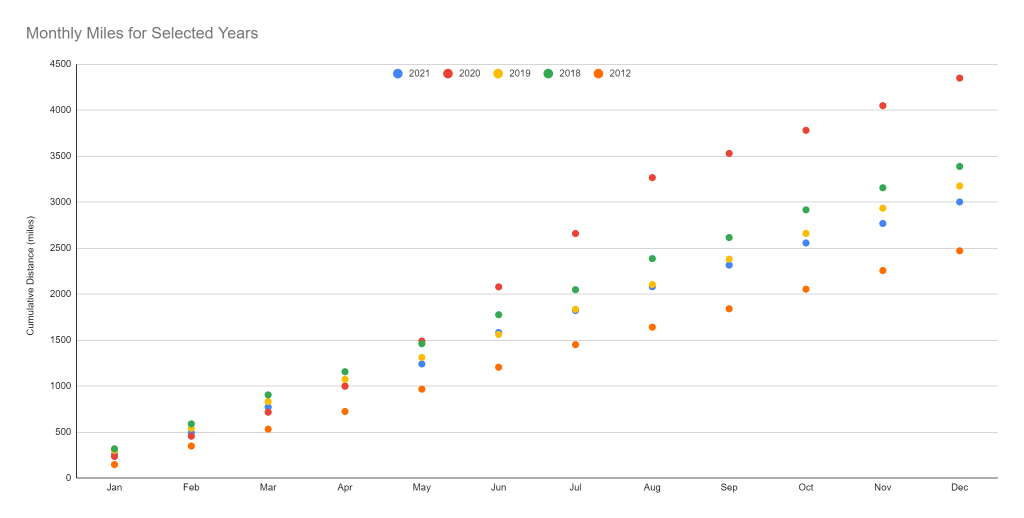
Figure 1: Cumulative monthly miles for selected years 2012, and 2018 to 2021

Figure 1 illustrates how I’ve done over the last ten years. The bottom set of points are from 2012; my lowest mileage year. The top set of points are for 2020; my highest mileage year. There are three sets of data in a range in between the lowest and highest. These are years 2018, 2019, and 2020.

I want to write in the future about my daily tracking methods – many times the fact that I was behind my goal got me motivated to do more miles. What I do every single day is how I cover many miles in a year. Another useful topic is how walking has affected my health; in general it’s been very positive but I ought to write my lessons learned.

Let me close by thanking all my friends and family who have put in miles with me. I always enjoy the company; hopefully you do as well. Of course, sometimes I have an excessive number of words per mile! Well, I have to dash off now; got a few miles to cover today.

Running my town

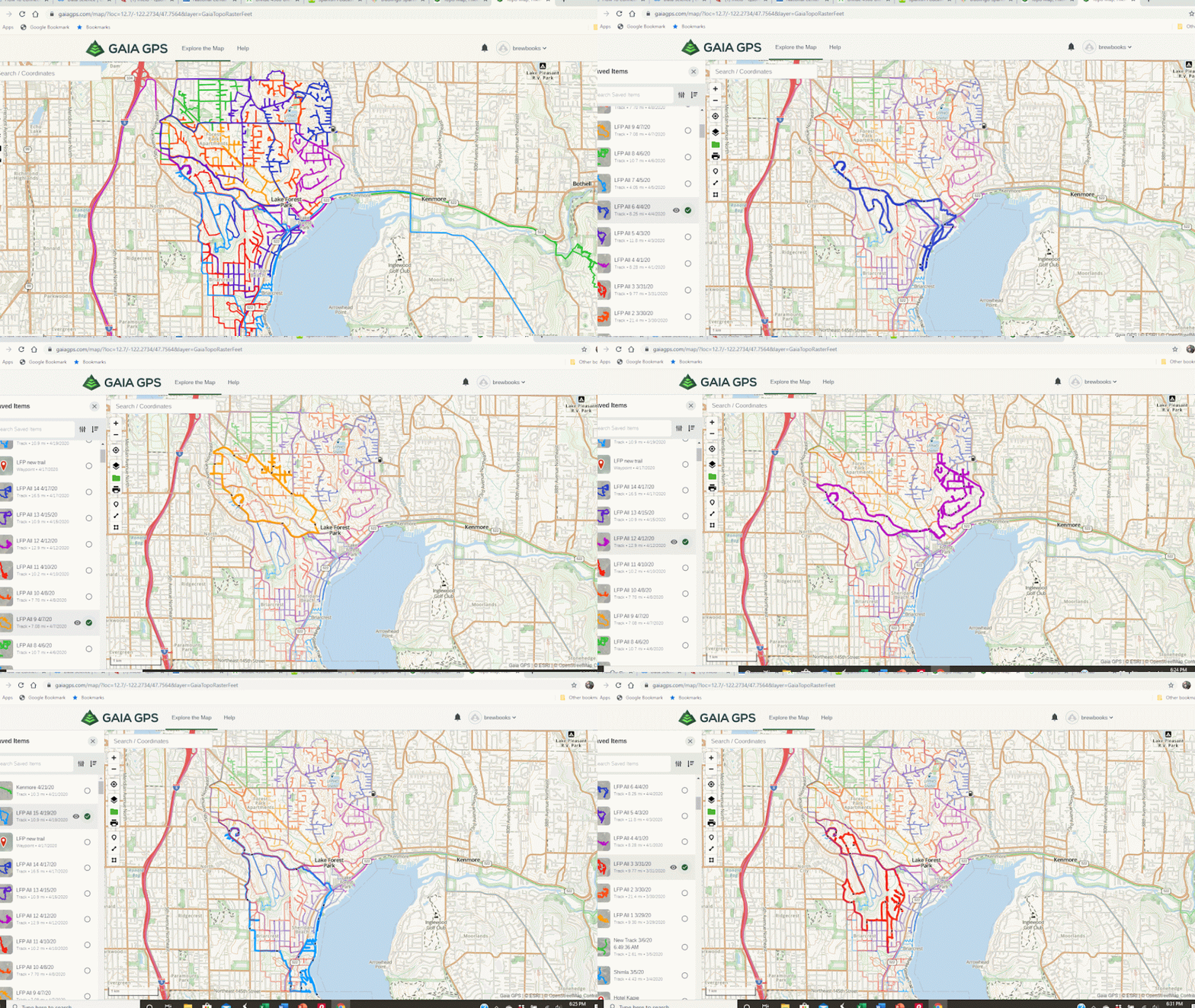
I did an interesting project in April, 2020 to keep in shape while staying at home during the COVID-19 pandemic. I ran and walked every street and a few trails in my town of Lake Forest Park, Washington.

I ended up doing 15 runs over 22 days for a total of 159.8 miles. My shortest run was 4 miles and the longest was over 21 miles. The average was about 7.2 miles. Our town has a few hills; my elevation gain was 10,730 feet (about the height of Mount Baker). For every run, I knew the area I wanted to explore but not the detailed path. The first thing I had to do was hike up the hill of our street and decide whether to go right or left?

Which way should I go today?

Along the way, I discovered lots of interesting places in my town and visited areas I’d never been to. I talked to a number of great people (from a distance), discovered some great views, enjoyed the spring beauty and had a lot of fun. Here’s a few images, there are more in my Run LFP 2020 album on Flickr.

The biggest little library I’d ever seen, I found my kind of book!
Creative idea
Wonderful place
Done!

The animation shows each days run, the details can be found on my Run LFP 2020 project log.